Athens Marathon 2026: Course, Elevation, Start Time & Where to Cheer
On November 8, 2026, the Athens Marathon leaves Marathon at 8:30 am and finishes in the Panathenaic Stadium. The course, the climb to km 31, buses, bag drop and the best places to cheer.
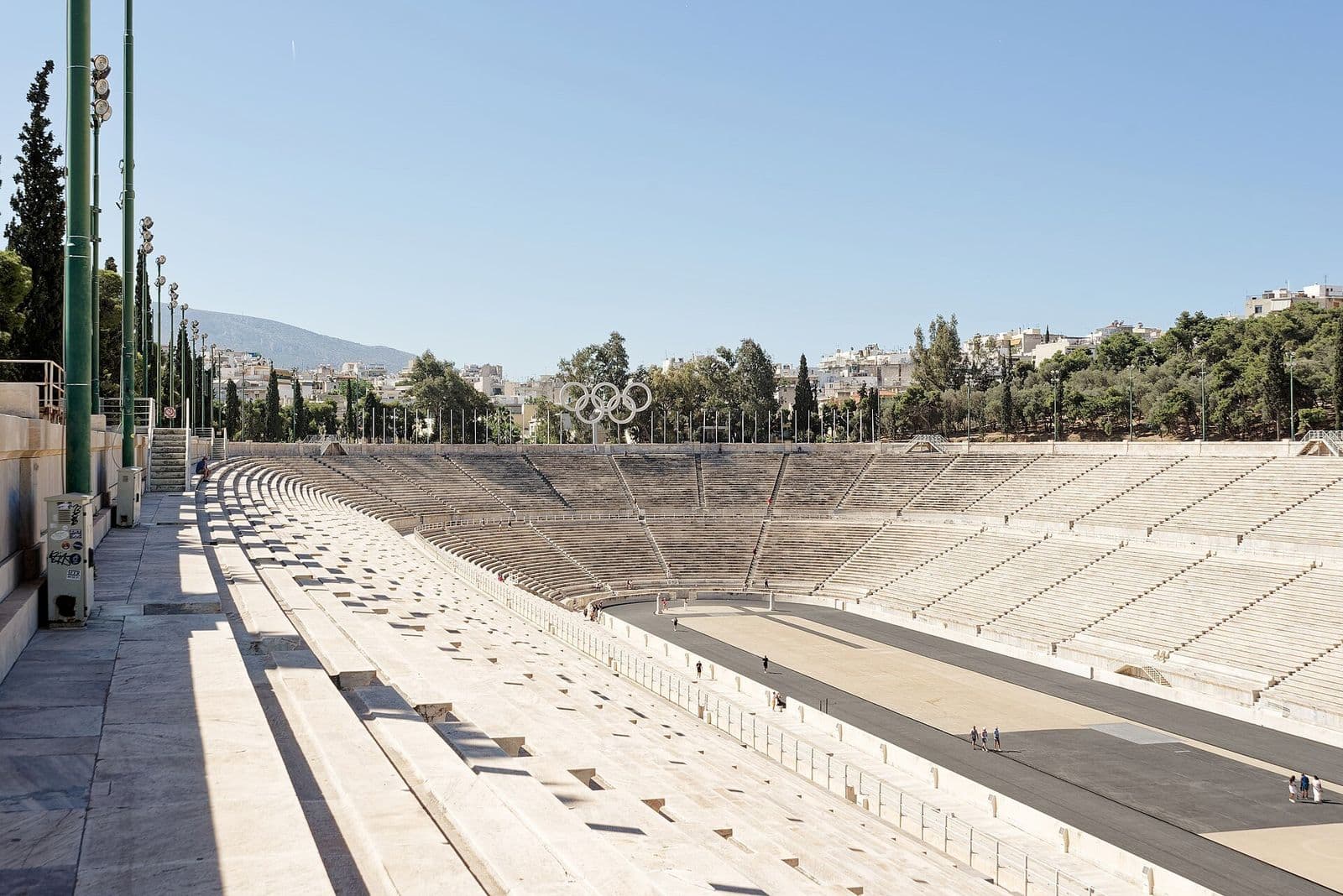
The Athens Marathon. The Authentic 2026 takes place on Sunday, November 8, 2026, with the first wave leaving the town of Marathon at 8:30 am (7:30 am in Paris) and the finish inside the marble Panathenaic Stadium. The course climbs, on and off, from around km 11 to its high point at the Stavros junction around km 31, then drops into central Athens. Here is the route section by section, how to pace that climb, how to get to the start, and where your supporters can see you.
Athens Marathon 2026 at a glance
- Date: Sunday, November 8, 2026 (43rd edition)
- Start: Marathon town, first block at 8:30 am, waves until about 10:15 am
- Finish: Panathenaic Stadium, the last 170 m on the track
- Time limit: 8 hours, with every finish closed by 6:15 pm
- Field: about 25,000 marathon runners, and 85,000 participants across the weekend's races
- Aid stations: 15, roughly every 2.5 km
- Age: 20 and over (born in 2006 or earlier)
Registration is closed and the race is sold out. Start lists are online, and each runner receives their bib number and start block by email about ten days before the race.
The course, section by section
The Athens course is a point-to-point route that follows the road between Marathon and Athens, the route linked to the legend of the messenger. It is not a course for a personal best, as the organisers' own description makes clear.
Km 0–10: Marathon and Nea Makri. The first 200 m run downhill out of the start area, and the first 4 km on Marathonos Avenue lose a little height. Between km 4 and km 6 the route loops around the Tomb of the Marathon warriors, then runs flat through Nea Makri until km 10. It feels easy, which is exactly the trap.
Km 11–20: the first climbs. From km 11 to km 17 the road goes uphill in parts, then drops steeply before the Rafina junction. After the junction it climbs again, with the hardest part of this section just before km 20.
Km 20–31: Pikermi, Pallini, Gerakas, Stavros. You pass halfway (21.1 km) around Pikermi, where short climbs and flatter stretches alternate. Around km 25 comes a long uphill drag, then Pallini (km 27–28) keeps climbing. From Gerakas starts the last and hardest climb, up to the Stavros junction at km 30–31, the highest point of the course.
Km 31–42.2: down into Athens. A steep descent takes you to Agia Paraskevi, then Mesogeion Avenue through Chalandri and Cholargos, alternating flat and downhill. The steepest drop runs from the Ministry of National Defence to the Katechaki junction (km 37.5), where you pass under the bridge. Then Michalakopoulou Avenue, Feidippidou Street, Vasilissis Sofias Avenue past the Athens Concert Hall and Eleftherias Park (km 40, the last aid station), towards Syntagma, left onto Irodou Attikou (km 41.2) along the National Garden, and into the stadium.
Elevation profile: what the official GPX shows
The organisers publish the course as a GPX file. Read kilometre by kilometre, it gives this approximate profile:
- Km 0: 37 m, downhill start
- Km 5–10: 8–20 m, flat, Nea Makri
- Km 15: 59 m, first climbs
- Km 20: 71 m, after the Rafina junction
- Km 25: 161 m, long climb begins in earnest
- Km 28–30: 208–211 m, Pallini and Gerakas
- Km 31: about 245 m, Stavros, the top
- Km 35: 193 m, Mesogeion Avenue
- Km 40: 126 m, Vasilissis Sofias
In other words, about 230 m of net gain between Nea Makri and Stavros, most of it in the 15 km after halfway. The file shows roughly 340 m of cumulative climbing over the full distance.
How to pace the climb to km 31
Most runners who struggle in Athens do so because they ran the first 10 km at goal pace on a flat, slightly downhill road. A few practical rules:
- Run the first 10 km a little slower than goal pace. You will need that margin between km 20 and km 31.
- Pace the climbs by effort, not by your watch. Losing 10 to 20 seconds per kilometre on the long drags is normal. Chasing your split there costs more later.
- Save something for the descent. From km 31, gravity helps your lungs, but your quads have already done the work. Short, quick steps hurt less than long strides.
- Use the aid stations. Every 5 km you get water and isotonic drink, with gels at km 10 and km 20, bananas from km 20 and cola from km 30. In between (7.5, 12.5, 17.5 km...) there are water and sponges.
If the wall is what scares you, it usually arrives right here, at the top of the climb, with 11 km still to go. Planning a voice you trust for that point changes a lot.
Getting to the start and race morning
Organiser buses take registered runners to Marathon with no booking needed. For blocks 1 to 10, they leave central Athens between 5:00 and 6:30 am from six points, including Syngrou-Fix (last bus 6:15 am), Syntagma, Panepistimio, Evangelismos, Katechaki and Omonia. For blocks 11 to 15, buses leave between 6:30 and 7:30 am from Ethniki Amyna, Cholargos, Katechaki and Nomismatokopio, all on Mesogeion Avenue. The organisers advise against driving to the start.
There is no bag drop at the start. You hand in your bag at the allwyn Marathon Expo (Faliro Indoor Hall, former Taekwondo venue) between Wednesday, November 4 and Saturday, November 7, and you pick it up after the finish on Vasilissis Olgas Avenue, by the National Garden. Pack dry clothes, wear the thermal poncho given out by the organisers, and leave spare layers in the clothing bins at the start: they are donated afterwards.
Where to watch the Athens Marathon
Central Athens is closed to traffic on race day from 5:00 am to 6:20 pm, and the organisers ask spectators to use the metro. Spectators may not run, cycle or walk in the runners' lane or the lane next to it. Most of the first 30 km, between Marathon and Pallini, are hard to reach on race morning without a car, so most supporters stay in the city.
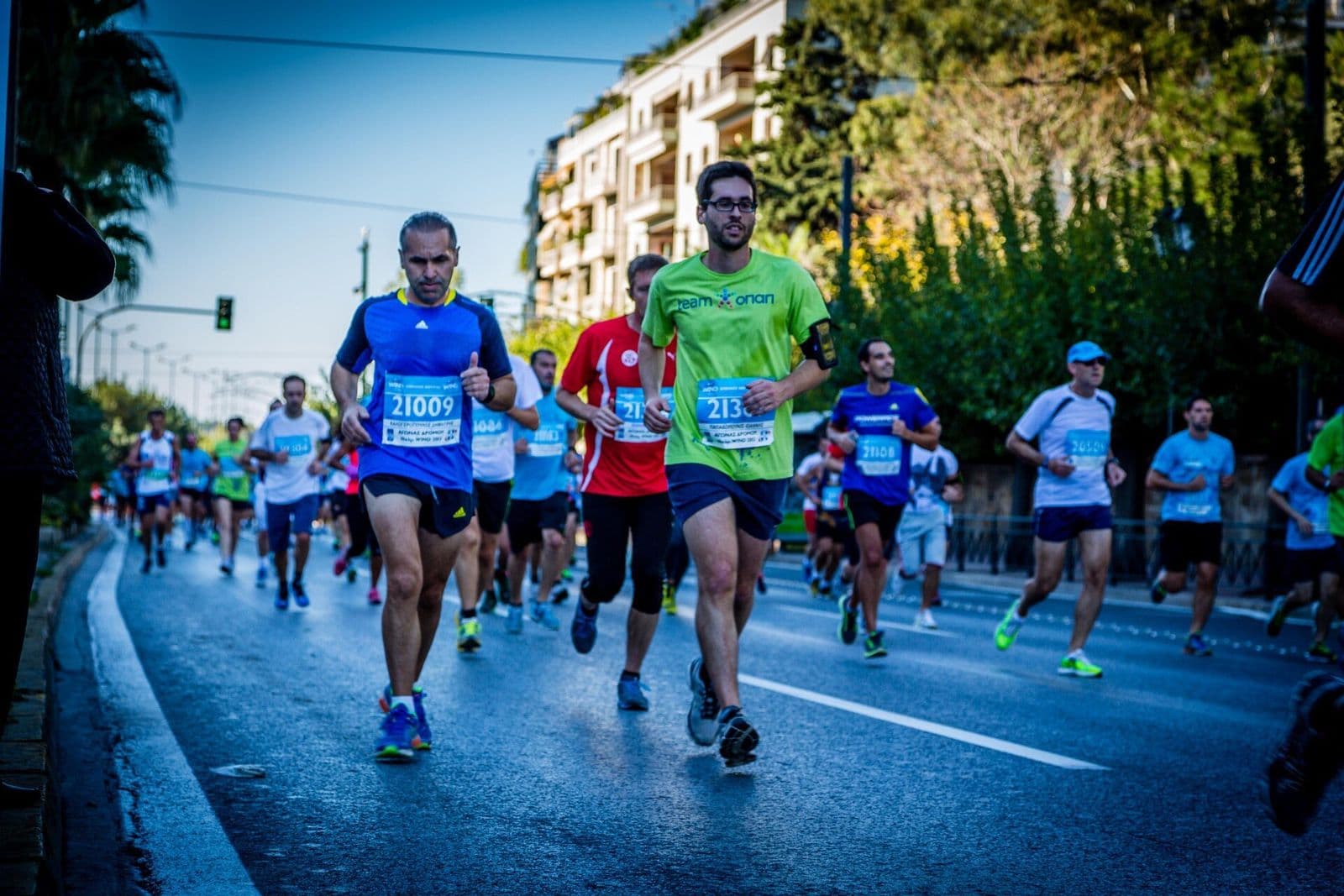
Mesogeion Avenue (km 34–37). Metro line 3 runs along this stretch, with Cholargos and Ethniki Amyna close to the route. Your runner is past Stavros and on the long descent, often hurting. This is where a familiar face matters.
Katechaki (km 37.5). The route passes under the bridge here, and the footbridge gives a wide view of the river of runners.
Vasilissis Sofias (km 39–41). Around the Athens Concert Hall (Megaro Mousikis metro) and towards Evangelismos, with 2 to 3 km to go. From Ethniki Amyna it is only a few stops on line 3, so seeing someone twice is realistic if you check the live tracking before heading down to the platform.
The Panathenaic Stadium. Entry to the stands is free, about 1 km from Syntagma, Akropoli and Evangelismos metro stations. Only finishers and staff get on the track. If the finish is what you most want to see, go straight there and accept that you will not catch an earlier point too. The organisers' estimate for the first man is around 10:39 am.
Agree on a meeting point before the race. As runners collect their bags on Vasilissis Olgas Avenue, a spot nearby along the National Garden is the simplest choice.
Following a runner live
The official Athens Authentic Marathon app (free, iOS and Android) has live tracking. Runners can turn on GPS tracking through "My Race" with their bib number and email. If they don't, their position is estimated from timing mats, every 5 km and at halfway. Spectators don't need an account and can follow up to 20 runners. For more options and tricks, see our guide on how to track a runner during a race.
Voice messages at the right kilometre
Not everyone who wants to support you will be in Athens. With Cobbr, your family and friends record voice messages ahead of time and pick the kilometre where you will hear them, in your headphones. With live messages, they can also react from home while following your race, through the same link.
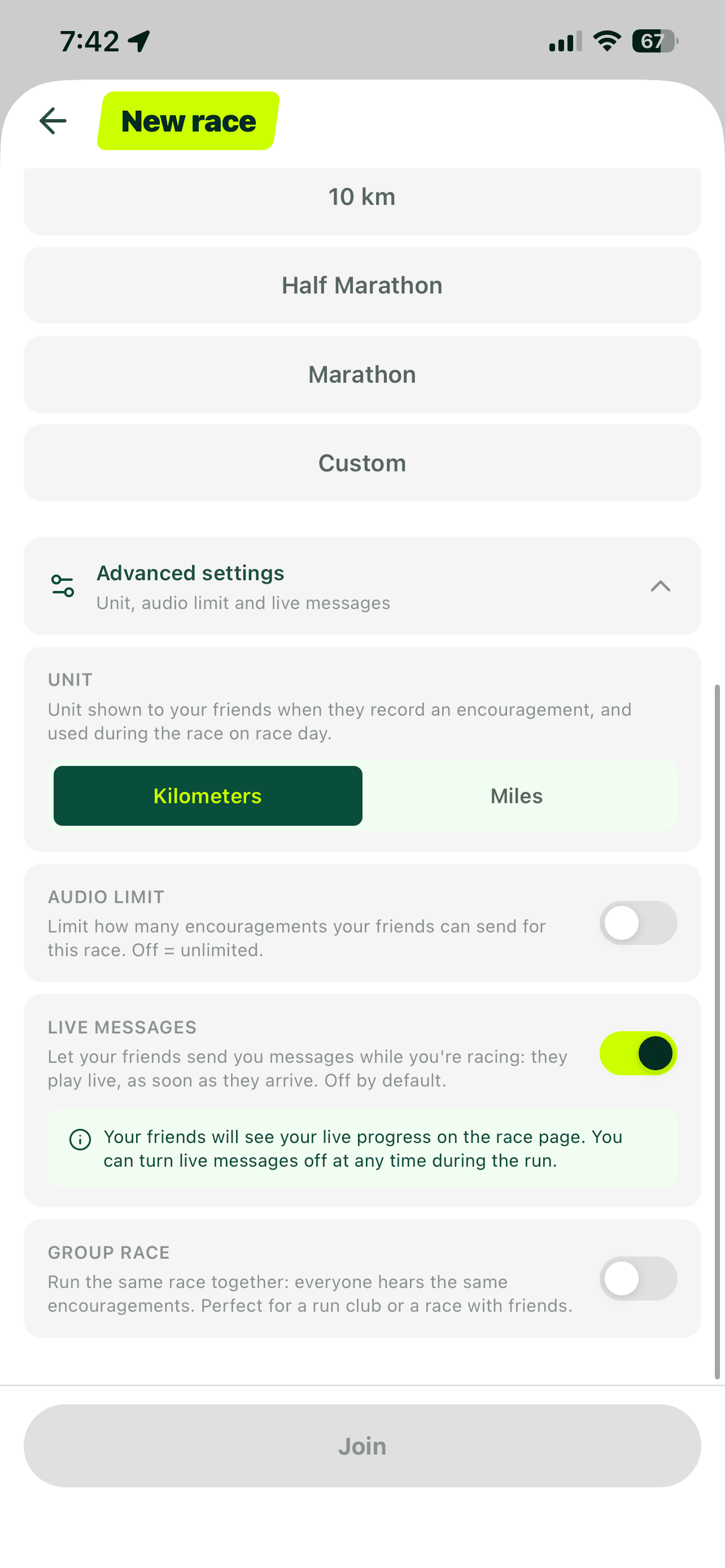
On this course, the kilometres where a message actually helps:
- Km 10, end of Nea Makri: a reminder not to bank time before the climbs.
- Km 21, halfway in Pikermi: the race starts here.
- Km 25: the long drag, a message to stay patient.
- Km 30–31, Stavros: the top of the course and the hardest point.
- Km 37.5, Katechaki: under the bridge, nearly home.
- Km 41, Irodou Attikou: one last word before the stadium.
For words that work, browse our encouragement messages for runners, and read how live messages while you run work.
Other autumn marathons
Running another big city race this autumn? We have course guides for the NYC Marathon, a week earlier, and the Berlin Marathon. And if you travel to Athens alone, these tips for running a marathon solo are worth a read.
FAQ
What time does the 2026 Athens Marathon start?
The first block leaves Marathon at 8:30 am on Sunday, November 8, 2026 (7:30 am in Paris). Waves follow until about 10:15 am, when the last runner crosses the start.
Is the Athens Marathon course hard?
Yes. It is mostly uphill from km 11 to km 31, rising from under 20 m at Nea Makri to around 245 m at the Stavros junction, with the hardest climb at km 30–31. The last 11 km are mostly downhill.
What is the time limit?
8 hours. All finishes close at 6:15 pm, including the delay of the later waves.
Where is the best place to watch?
Mesogeion Avenue (Cholargos or Ethniki Amyna on metro line 3) around km 34–37, then Vasilissis Sofias around km 40, or the Panathenaic Stadium, where entry to the stands is free.
Can I drop a bag at the start?
No. Bags are handed in at the Marathon Expo in Faliro between November 4 and 7, and collected after the finish on Vasilissis Olgas Avenue, by the National Garden.
Cover photo: Panathenaic Stadium, Jakub Hałun / Wikimedia Commons, CC BY 4.0. Body photo: Thodoris Karakozidis / Wikimedia Commons, CC BY 3.0.