Mont Ventoux Half Marathon: Course Analysis and Strategy Tips
ake on one of Europe's toughest half marathons with our complete guide to the Mont Ventoux Half Marathon. Discover a detailed course analysis, elevation profile, key climbing sections, aid stations, pacing strategies, and expert tips to help you reach the summit of the Giant of Provence. Learn how Cobbr lets you receive personalised audio encouragements from friends and family during your ascent.
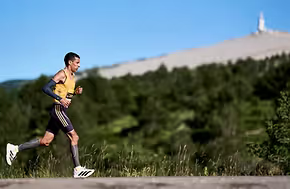
Mont Ventoux Half Marathon: Course Analysis, Strategy Tips and Audio Encouragements with Cobbr
The Mont Ventoux Half Marathon is often described as the toughest half marathon in Europe. At the very least, it is certainly one of the most challenging races in France. When you look at the numbers, it is easy to understand why: 21.6 km of almost uninterrupted climbing, 1,610 metres of elevation gain, and a finish line sitting over 1,910 metres above sea level at the summit of the Giant of Provence.
Unlike a traditional half marathon where runners try to maintain a steady pace, success here depends primarily on effort management, temperature control, and mental resilience.
In this article, we will analyse the course, identify the most challenging sections, and explore how to maximise your chances of reaching the summit.
Mont Ventoux Half Marathon at a Glance
- Distance: 21.6 km
- Elevation Gain: 1,610 m
- Start: Bédoin (315 m)
- Finish: Summit of Mont Ventoux (1,910 m)
- Date: July 5, 2026
- Start Time: 8:00 AM
- Cut-off at KM15 (Chalet Reynard): 2h30
- Finish Cut-off: 3h40
The entire route follows the famous D974 road, known worldwide from the legendary stages of the Tour de France. For race day, the road is fully reserved for runners.
Why This Half Marathon Is Unique
Most half marathons include flat or downhill sections that allow runners to recover.
On Mont Ventoux, however, you will face:
- No downhill sections
- Virtually no flat terrain
- Constantly increasing altitude
- Exposure to both sun and wind
- An average gradient of nearly 7.5% across the entire course
In reality, this event is closer to a timed mountain ascent than a traditional half marathon.
Detailed Course Analysis
Course profile available on the official Semi-Marathon du Mont Ventoux Kookabarra website as of June 15, 2026.
From the Start to Saint-Estève (KM0 to KM5)
The race starts in the village of Bédoin.
The opening kilometres are the "easiest" part of the course, but this is also where many runners make their biggest mistake.
The gradient ranges from 3% to 8%.
You will feel fresh and capable of running much faster.
That is exactly what you should avoid.
The strongest finishers often climb this section at what feels like an intentionally frustratingly easy effort.
The first aid station is located at KM5 in Saint-Estève.
From Saint-Estève to Cabane Jamet (KM5 to KM11)
This is where the race truly begins.
The road frequently reaches:
- 9%
- 10%
- Sometimes even steeper
The forest still provides some shade, but the climb becomes serious.
This is often the section where runners unknowingly exceed their sustainable effort level.
Heart rates rise quickly while running speed continues to drop.
A food and drink aid station is available at KM11.
From Cabane Jamet to Chalet Reynard (KM11 to KM15)
This is probably the most strategic section of the entire race.
The gradient remains consistently steep.
Chalet Reynard marks the race's main cut-off point:
- KM15
- Time limit: 2h30
If you reach this checkpoint with only a few minutes to spare, the final section can become extremely difficult.
For many runners, the primary objective is simply to arrive at Chalet Reynard with enough energy left to finish.
There is no need to panic, though. With proper training and smart pacing, this goal is entirely achievable.
From Chalet Reynard to Simpson Memorial (KM15 to KM18)
You gradually leave the forest behind.
The scenery becomes almost lunar.
The trees disappear.
The wind can become a major opponent.
The gradient remains demanding, often between 8% and 9%.
At this stage:
- The altitude starts to take its toll
- The quadriceps are already heavily fatigued
- Mental strength becomes crucial
A drinks-only aid station is located at KM18 near the Simpson Memorial.
The Final Three Kilometres: The Real Ventoux
This is the section made famous by cycling.
The landscape becomes entirely rocky and barren.
The summit appears close.
Yet the final kilometres feel endless.
Some sections still reach gradients of 8% to 10%.
The wind can dramatically increase the difficulty of the climb.
Runners who paced themselves well often gain many positions here.
Those who started too hard suffer greatly.
Finally, the iconic Mont Ventoux tower comes into view.
The finish line is located at approximately 1,910 metres above sea level.
What Strategy Should You Adopt?
If Your Goal Is Simply to Finish
- Start conservatively
- Begin fuelling within the first hour
- Power-hike the steepest sections
- Prioritise heart rate management over pace
For Experienced Runners
- Maintain a constant effort rather than a constant pace
- Monitor heart rate closely
- Follow a structured nutrition plan
- Save as much energy as possible before Chalet Reynard
Many trail runners consider a 21 km course with 1,600 m of elevation gain to require an effort comparable to a marathon, or even more depending on the athlete's level. Discussions among participants often reveal finish times that are nearly double those of a flat half marathon.
Nutrition and Hydration
The organisation provides several aid stations:
- KM5: Drinks
- KM11: Food and drinks
- KM15: Food and drinks
- KM18: Drinks
- Finish: Food and drinks
Despite this, many runners still carry:
- A soft flask
- A few energy gels
- Electrolytes in case of high temperatures
Mont Ventoux in July can be very hot during the lower part of the climb.
Cobbr: Receive Audio Encouragements During Your Climb
The Mont Ventoux Half Marathon is a race where mental strength plays a huge role.
With Cobbr, your friends and family can record audio messages before race day.
During your climb, the app automatically plays these encouragements at key moments selected by your loved ones, such as:
- Before Chalet Reynard
- During the final kilometres
- Approaching the summit
- On the toughest sections of the course
Imagine hearing:
"Come on Dad, we're waiting for you at the summit!"
or
"You're stronger than this mountain!"
right when your legs begin to feel heavy.
For many participants spending more than three hours climbing, these messages can make a genuine difference.
FAQ: Mont Ventoux Half Marathon Course Analysis
Is the Mont Ventoux Half Marathon Really the Toughest in Europe?
It is often presented that way by the organisers. With 21.6 km and 1,610 m of elevation gain, it is unquestionably one of the most demanding road half marathons in Europe.
Which Kilometre Is the Hardest?
Many runners point to the section between Chalet Reynard and the summit. Fatigue, altitude, and wind exposure combine to make it particularly challenging.
Is Walking Allowed?
Absolutely. Many participants alternate between running and brisk walking on the steepest sections to conserve energy.
Should I Target a Specific Pace?
Generally not, unless you are specifically trained for mountain racing. Running by effort or heart rate is usually more effective than focusing on pace.
What Is the Average Gradient?
The average gradient exceeds 7% across the entire route, with several kilometres between 8% and 10%.
Are the Cut-Off Times Difficult?
The main challenge is reaching KM15 (Chalet Reynard) within 2h30. Specific hill training is highly recommended.
Can I Set a Personal Half Marathon Record?
Very unlikely. Finish times are not comparable to those achieved on a flat half marathon. This event should be viewed as a timed mountain ascent.
What Weather Conditions Should I Expect?
You may experience warm temperatures at the start in Bédoin and cool, windy conditions at the summit. Bringing warm clothing in your drop bag is usually a good idea.
Conclusion
The Mont Ventoux Half Marathon is much more than a race.
It is a legendary climb that tests your legs, your cardiovascular fitness, and above all, your mental strength.
If you are preparing for this challenge, focus less on pace and more on effort management. A well-paced ascent to Chalet Reynard will give you every opportunity to enjoy the final kilometres towards one of France's most iconic summits.
And when the road steepens beneath the famous Ventoux tower, hearing the voices of your loved ones through Cobbr might be exactly the boost you need to reach the finish line.