Maxi-Race Annecy – Half Tour of the Lake: Course Analysis, Difficulty, Race Strategy & Tips to Conquer This Iconic Mountain Trail
Discover our complete analysis of the Maxi-Race Annecy Half Tour of the Lake: course profile, climb and descent strategy, real difficulty level, and expert advice for succeeding in this iconic trail race around Lake Annecy.
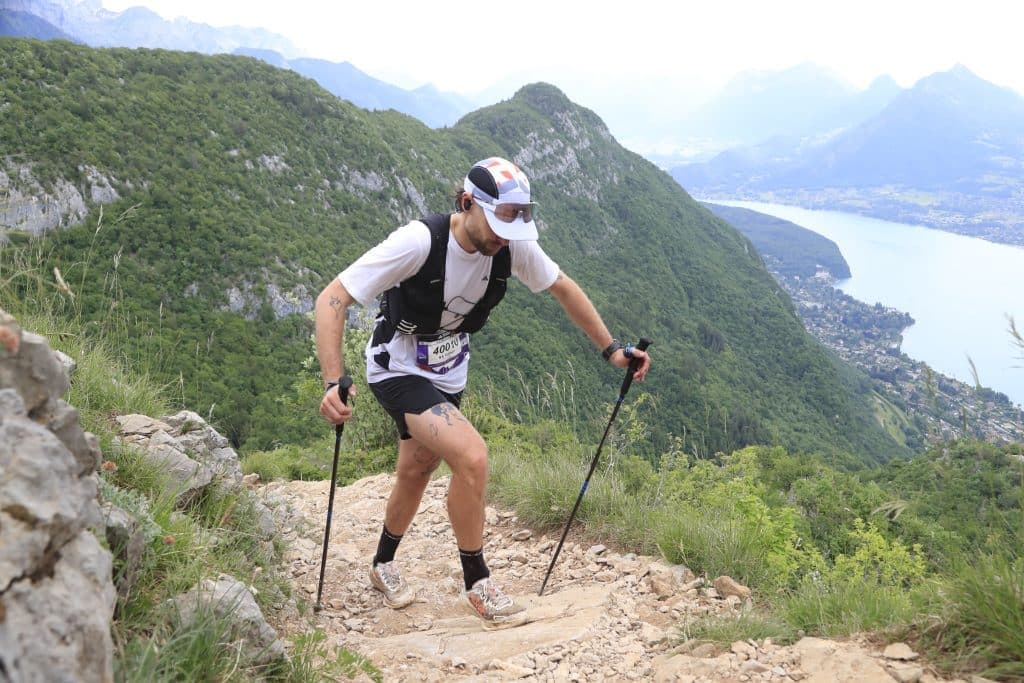
When people talk about trail running around Lake Annecy, they often immediately think about the full Tour du Lac.
But there’s another format that attracts plenty of runners looking for a serious mountain challenge without committing to the full ultra experience: the Half Tour of the Lake (Demi Tour du Lac) at Maxi-Race.
With roughly 40–60 km depending on the edition, several thousand meters of elevation gain, stunning scenery, and true mountain terrain, this is definitely not a “small 50K.”
So what should you expect? Is the course technical? Where are the real challenges? How should you pace yourself?
Here’s our breakdown of the Maxi-Race Annecy Half Tour of the Lake.
The Half Tour of the Lake: A Real Mountain Trail, Not Just a “Shorter Maxi-Race”
Don’t let the name fool you.
The Half Tour of the Lake is still a serious mountain race.
Depending on the edition, runners usually face around 45–55 km with 2,000 to 3,500+ meters of elevation gain.
That means you’ll need:
- genuine trail endurance
- the ability to climb for long periods
- solid nutrition management
- legs capable of handling long alpine descents
This isn’t necessarily the ideal choice for a first mountain trail.
But it can be an outstanding goal for road runners or trail runners looking to step up to the next level.
The DNA of the Course: Mountains, Lake Views & Tough Sections
Maxi-Race doesn’t do things halfway.
The Half Tour of the Lake carries the event’s signature style:
panoramic ridgelines, long forest climbs, technical single tracks, and spectacular views over Lake Annecy.
Honestly, it’s hard to find a more photogenic trail setting.
The course typically combines:
- runnable forest paths
- long, sustained climbs
- more technical mountain terrain
- descents that heavily challenge your quadriceps
- panoramic sections overlooking the lake and surrounding mountains
In short: a trail that rewards both your legs… and your eyes.
Course Strategy: Where the Half Tour Is Won (or Lost)
The Start: Don’t Race It Like a Flat 50K
This is probably one of the most common mistakes.
The start line atmosphere can tempt runners to attack early.
Bad idea.
In a mountain trail of this format, pacing is everything.
If you approach it with a “road marathon” mindset, the consequences may arrive very early.
The smarter approach:
- accept walking parts of the climbs
- manage intensity from the beginning
- monitor breathing, heart rate, and fueling
Mountain trails rarely reward heroic starts.
The Climbs: The Real Key to the Day
Like many alpine races, the Half Tour is largely decided on the climbs.
The question isn’t “does it climb?”
The real question is: how long can you climb efficiently?
Climbing strategy becomes crucial:
- steady cadence
- short, economical steps
- muscular efficiency
- intelligent pole usage (if permitted under race regulations)
Experienced trail runners often gain significant time not by running faster… but by power-hiking better.
The Descents: The Silent Trap
Most runners train for climbing.
Far fewer truly prepare for descents.
And yet…
At Maxi-Race, descents can cost a huge amount of energy.
Burning quads, reduced concentration, less precise footing…
The second half of the race becomes much harder if you attacked too aggressively downhill.
Simple advice:
control before aggression.
Better to lose 2 minutes on a technical descent… than lose 30 minutes later because your legs are completely gone.
The Final Part: Managing Alpine Fatigue
The final third of the Half Tour is often where the race reveals its true personality.
Muscular fatigue builds.
Focus starts fading.
Nutrition becomes even more important.
This is usually where your early pacing strategy either pays off… or comes back to haunt you.
If you’re still able to run smoothly on the faster sections late in the race, you’ve probably managed your effort well.
What Kind of Terrain Should You Expect?
Small spoiler:
this is not a smooth gravel path through a city park.
Expect:
- mountain trails
- rocky terrain
- rooty sections
- sustained alpine climbs
- descents that can become technical depending on weather conditions
And weather can completely change how the course feels.
Heat, humidity, rain, slippery terrain…
Annecy can quickly remind you that you’re racing in a true mountain environment.
Best Places to Cheer on Runners During the Half Tour of the Lake
One of the great things about a race like Maxi-Race is that support can genuinely change a runner’s day.
And in mountain racing, encouragement often matters even more than in road running.
Here are a few strategic areas worth considering, depending on official access rules and race logistics.
Aid Stations
Often the best spectator locations.
Runners slow down, eat, regroup… and encouragement here can completely reset their mental state.
Maxi-Race includes several aid stations throughout its formats.
The End of Major Climbs
After a long climb, seeing a familiar face can make a huge difference.
Mentally, it often feels like reaching a mini finish line within the race.
Annecy / Finish Area Sections
Of course.
The atmosphere naturally builds as runners approach the finish.
Even after several hours of effort, hearing your name or seeing a loved one can completely change the final kilometers.
What If Your Friends and Family Can’t Be There? Get Encouraged Anyway
Not everyone has friends or family available to spend a full day in the mountains.
Between travel, logistics, mountain access, and schedules, it’s not always easy.
But that doesn’t necessarily mean racing alone.
With Cobbr, runners can receive personalized voice messages from loved ones during their race, automatically triggered at specific kilometers.
Imagine:
a message before a major climb.
An encouragement during a difficult section.
Or a familiar voice before the final kilometers of the Half Tour of the Lake.
Sometimes, hearing someone at exactly the right moment can genuinely change the course of a race.
Discover the app here: https://cobbr.app
FAQ – Maxi-Race Half Tour of the Lake
What is the distance of the Half Tour of the Lake?
Depending on the edition, the Half Tour of the Lake is generally around 45–55 km.
How much elevation gain does the Half Tour of the Lake have?
The course typically features several thousand meters of elevation gain, depending on the year and course adjustments.
Is the Half Tour of the Lake technical?
Yes.
This is a true mountain trail featuring long climbs, demanding descents, and alpine terrain.
Can you run the Half Tour of the Lake as your first trail race?
As a first short mountain trail: probably ambitious.
For runners with prior trail or marathon experience and a specific preparation plan, it can become an excellent challenge.
Where can I find official information?
Official race information, course maps, regulations, registration, and updates are available on the official Maxi-Race website: