Geneva Marathon 2026: Course, Tips and Motivation to Succeed in Your Race
Running the Geneva Marathon 2026? Discover the course analysis, key difficult sections, pacing advice, hydration tips and mental strategies to stay strong throughout the race. Learn where to push, where to stay controlled and how motivation can make the difference on marathon day.
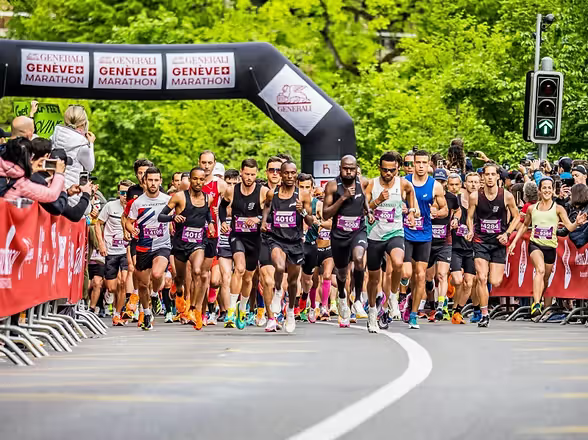
Geneva Marathon 2026: Course, Tips and Motivation to Succeed in Your Race
The Geneva Marathon is one of the most appreciated European marathons among runners looking for the perfect balance between performance, scenery and atmosphere. Every year, thousands of participants run between countryside, lake views and the city center with the goal of living a memorable experience or achieving a personal best.
The Geneva Marathon 2026 is approaching quickly, and if you are taking the start line this year, you are entering a very specific phase. The physical preparation is almost complete. A few days before the race, what will make the difference is no longer only your training volume or the number of specific sessions you completed. Your success will mainly depend on your ability to manage your effort, your mindset and your energy all the way to the finish line.
In this article, you will discover the Geneva Marathon 2026 course, the key sections where you need to stay disciplined, the areas where you can push harder, and the best strategies to stay motivated throughout the race.
Geneva Marathon 2026: A Fast but Demanding Marathon
The Geneva Marathon has a unique reputation. Many runners consider it a fast marathon thanks to its relatively accessible course profile. However, this race is often harder than it looks.
The route alternates between fast countryside sections and more urban areas as runners approach Geneva. This variety makes the marathon mentally enjoyable, but it also requires proper pace management because some parts of the course can disrupt your rhythm.
Main Characteristics of the Geneva Marathon 2026
- Official distance of 42.195 km
- Start outside the city center
- Finish in the heart of Geneva
- Relatively fast and rolling course
- Combination of rural and urban sections
- Strong crowd support in the final kilometers
The biggest advantage of the Geneva Marathon is that it allows runners to maintain a steady pace during a large portion of the race. For runners targeting a personal best, it is a very attractive marathon.
However, there is an important trap. Fast courses often encourage runners to start too aggressively.
Geneva Marathon 2026 Course Analysis: Where to Push and Where to Control Yourself
Understanding the course before race day is a major advantage. It helps anticipate difficult moments and identify exactly where it is possible to accelerate.
From the Start to Kilometer 10: The Most Dangerous Section
The opening kilometers of the Geneva Marathon are often where mistakes happen.
The sensations are excellent. The energy at the start line is exciting. The legs feel fresh. As a result, many runners unknowingly go faster than their target pace.
This is probably the section where discipline matters the most.
What You Should Do
- Run slightly below your target pace
- Ignore runners accelerating around you
- Keep the effort comfortable
- Focus on controlled breathing
What You Should Avoid
- Trying to “build a time buffer”
- Following groups that are too fast
- Accelerating on false flats
A marathon is never won in the first 10 kilometers. However, it can absolutely be lost there.
From Kilometer 10 to Kilometer 25: The Perfect Zone to Settle In
This part of the Geneva Marathon 2026 is probably the most enjoyable.
The body starts finding its natural rhythm. Breathing becomes more stable. Mentally, fatigue remains relatively low.
This is where you truly build your race.
Goals During This Section
- Fully stabilize your pace
- Optimize hydration
- Start anticipating future fatigue
- Save as much mental energy as possible
This is also a great moment to enjoy the scenery and avoid obsessing over the remaining distance.
Many runners make the mistake of trying to “gain time” here because they feel strong. However, sensations before kilometer 25 rarely reflect the real state of the body.
From Kilometer 25 to Kilometer 35: The Real Start of the Marathon
This is often where the marathon truly begins.
Energy reserves progressively decrease. Muscular fatigue accumulates. Mentally, the race becomes much harder.
The section around kilometer 30 is especially important during the Geneva Marathon.
Common Signs of Fatigue
- Slight but progressive pace drop
- Heavy legs
- Difficulty maintaining focus
- Negative thoughts appearing
This part of the course is often where the gap grows between runners who managed their effort correctly and those who started too fast.
Where You Can Push Slightly Harder
If you still feel relatively strong at kilometer 30, that is a very positive sign.
You can then start to:
- Slightly increase your pace
- Gradually catch other runners
- Use the crowd’s energy
- Focus on intermediate goals
Mental strength plays a huge role here. Passing runners during this section often provides a major psychological boost.
The Final Kilometers in Geneva: The Last Mental Battle
The final kilometers of the Geneva Marathon are often the most emotionally intense.
The atmosphere becomes louder as you approach the city center. The crowd gets denser. At the same time, fatigue usually reaches its peak.
Paradoxically, this is also when external support becomes the most powerful.
Why This Section Is So Difficult
- The body is close to its energy limits
- Every acceleration becomes expensive
- Mental clarity decreases
- The brain naturally wants to slow down
But this is also where runners can achieve incredible things through mental strength.
Best Tips to Finish Strong
- Mentally break down the final kilometers
- Focus only on the next landmark
- Use the crowd as an energy source
- Maintain strong running posture
Very often, the runners who finish strongest are not necessarily the ones with the highest fitness level at the start. They are the ones capable of staying mentally engaged until the end.
Why Mental Strength Is Essential in a Marathon
The marathon is a unique race because it combines physical endurance with mental resilience.
Even with excellent preparation, almost every runner experiences moments of doubt.
The problem is that fatigue completely changes your thinking:
- The kilometers feel longer
- The pace suddenly feels harder
- The brain searches for excuses to slow down
- Motivation can disappear quickly
This is exactly why encouragement has such a huge impact on performance.
Why Encouragement Completely Changes a Race
During a marathon, sometimes a single message is enough to completely relaunch a runner.
Encouragement can:
- Break negative mental spirals
- Restore energy
- Help maintain pace
- Remind runners why they started
Emotional support plays a much bigger role than most people imagine.
In a marathon, fatigue is never purely muscular. It also becomes deeply mental.
Cobbr: Receive Voice Encouragement During the Geneva Marathon
Cobbr allows runners to automatically receive voice messages from loved ones during the race.
The process is simple:
- You share a link with friends and family before the marathon
- They record personalized voice messages
- The messages are automatically played during the race using GPS triggers
Why Voice Messages Are So Powerful
Unlike a playlist or motivational music, a familiar voice creates an immediate emotional reaction.
Hearing:
- your partner
- your friends
- your family
- your children
exactly when your legs start feeling heavy can completely change the dynamic of your race.
The Best Moments to Receive Encouragement During the Geneva Marathon
Some moments of the course are especially strategic.
Around Kilometer 30
This is often when the famous marathon wall appears.
Receiving a message here can help:
- Relaunch mental energy
- Prevent a pace collapse
- Break negative thoughts
Between Kilometer 35 and Kilometer 40
Fatigue becomes extremely significant.
Encouragement can then act as a second emotional wind.
During the Final Kilometer
The final kilometer is often filled with emotion.
Hearing the voice of a loved one at that moment can make the finish line even more powerful and memorable.
Final Tips Before the Start of the Geneva Marathon 2026
A few days before the race, simplicity becomes the most important thing.
What You Should Do
- Sleep well during the previous nights
- Prepare your gear in advance
- Stay committed to your strategy
- Hydrate properly
- Avoid unnecessary stress
Common Mistakes to Avoid
- Testing a new gel
- Changing shoes at the last minute
- Starting too fast
- Panicking during difficult moments
A marathon is rarely a perfect race. Almost every runner experiences difficult moments. What matters most is how you respond to them.
Conclusion
The Geneva Marathon 2026 is an incredible opportunity to experience a memorable race or achieve a major performance. Its fast course allows runners to move quickly, but it also requires proper pacing and strong mental control.
Understanding the key sections of the course, anticipating difficult phases and using every possible source of motivation can completely transform your race experience.
And sometimes, during the hardest moments, a simple familiar voice is enough to keep you moving forward.