Grand Trail Saint-Jacques by UTMB 100K: Course Analysis, Elevation Profile and Race Strategy
he Grand Trail Saint-Jacques by UTMB 100K is one of France's most iconic ultra-trail races. Explore a detailed analysis of the course, elevation profile, key climbs, challenging sections and race strategy tips. Learn how to manage your effort across the volcanic landscapes of Haute-Loire and prepare for one of the most demanding trail running adventures on the Camino de Santiago.
The Grand Trail Saint-Jacques by UTMB has become one of the must-run long-distance trail races in France. Between the volcanic landscapes of Haute-Loire, the historic Camino de Santiago trails, and a demanding course profile, this race attracts thousands of trail runners every year in search of both a physical and mental challenge.
While the distance alone is impressive, it is the course profile that truly defines the race. Using the official elevation profile, we will break down the key challenges of the route, identify the sections runners should prepare for, and explain how staying connected to your loved ones through Cobbr's audio encouragements can help you stay motivated for hours on the trail.
Grand Trail Saint-Jacques by UTMB 100K at a Glance
- Distance: approximately 86.7 km
- Start: Monistrol
- Finish: Le Puy-en-Velay
- 7 main aid stations
- Multiple long climbs
- A highly demanding central section
- A faster but still challenging final segment
The course follows part of the famous Camino de Santiago while crossing some of the most beautiful landscapes in Haute-Loire.
Detailed Elevation Profile Analysis
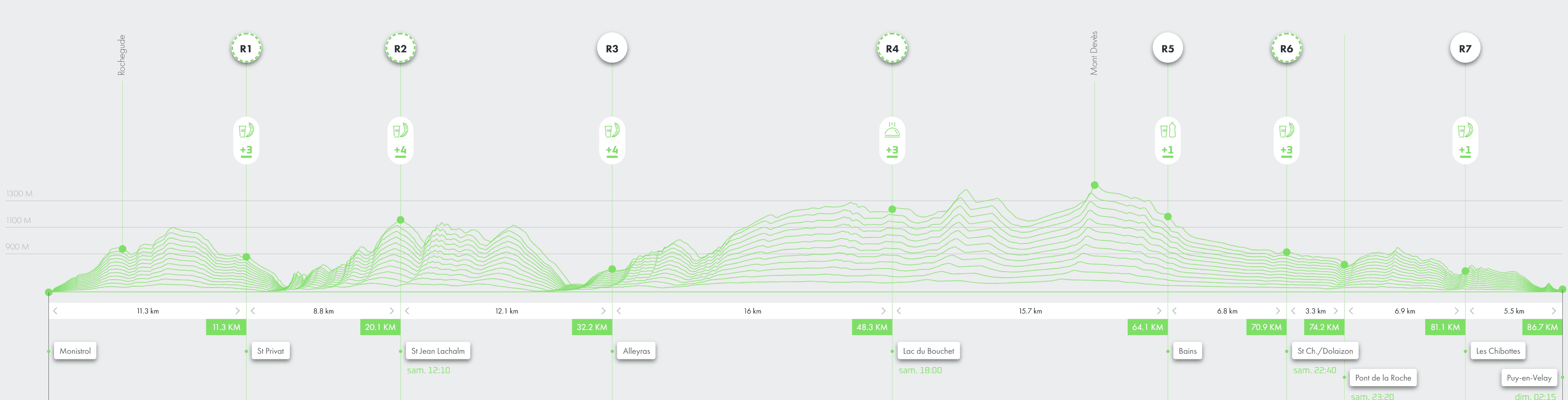
Monistrol Start: A Deceptive Opening Section
The first kilometres appear relatively manageable.
Between Monistrol and the first aid station at Saint-Privat (11.3 km), the course alternates between short climbs and descents with several rolling hills.
The classic mistakes here are:
- Starting too fast
- Following a stronger group
- Wasting energy unnecessarily
Your legs are fresh and race-day adrenaline often pushes runners to go faster than planned.
For an ultra-distance event, this first section should be treated as an extended warm-up.
Towards Saint-Jean-Lachalm: The First Real Challenge
Between Saint-Privat and Saint-Jean-Lachalm (20.1 km), the profile becomes more demanding.
A longer climb appears just before Aid Station R2.
This is usually the first point where meaningful gaps begin to form between runners.
At this stage:
- Regular fueling becomes essential
- Hydration must already be a priority
- Pacing should remain conservative
Towards Alleyras: A Series of Energy-Draining Climbs
The section leading to Alleyras (32.2 km) is particularly deceptive.
The profile features multiple intermediate climbs that prevent runners from finding a steady rhythm.
There is no single spectacular obstacle, but rather a constant accumulation of small efforts that gradually wear down the quadriceps and calves.
After roughly 30 kilometres, muscular fatigue is already beginning to appear for many runners.
Don't give up.
The Heart of the Course: The Major Mountain Section
This is where the Grand Trail Saint-Jacques is truly decided.
Between Alleyras and Lac du Bouchet (48.3 km), and then towards Bains (64.1 km), runners face the most demanding part of the course.
This section features:
- A long sustained climb
- Multiple summits
- Very little recovery between efforts
- Prolonged exposure to higher elevations
The profile resembles a succession of climbing waves that peak around kilometre 60.
This section arrives precisely when:
- Energy reserves begin to decline
- Mental fatigue appears
- Darkness may start setting in for some runners
This is often where mental strength begins to fade. Stay focused and remember all the training that brought you here.
The Psychological High Point of the Race
Around kilometre 60 to 65, the course reaches its highest point.
On paper, this may seem encouraging.
In reality, ultra-trail descents are never free.
After more than 60 kilometres of running, the quadriceps absorb significant impact forces and maintaining concentration becomes increasingly difficult.
This section requires solid technical skills to avoid mistakes and injuries.
Believe in yourself and trust the training that has carried you this far.
The Final Kilometres: Beware of the False Flat Downhill
After Bains (64.1 km), the profile gradually trends downhill.
However, the race remains demanding until the very end.
The sections around:
- Saint-Christophe-sur-Dolaison (70.9 km)
- Pont de la Roche
- Les Chibottes (81.1 km)
still contain several short climbs.
These may look insignificant on the profile, but after more than ten hours of racing they can feel enormous.
This is often where mental strength makes the difference.
Key Sections to Anticipate
Kilometres 15 to 35
A constant accumulation of small climbs that gradually wear runners down.
Kilometres 35 to 65
The toughest part of the race.
Kilometres 65 to 85
A deceptive section that feels easier but includes many pace-breaking climbs.
Final Kilometres Towards Le Puy-en-Velay
Mental resilience becomes crucial despite the proximity of the finish line.
Why Encouragements Matter During an Ultra
In a race of this duration, the challenge is not purely physical.
Difficult moments usually arrive when:
- Fatigue sets in
- Legs become heavy
- Motivation drops
- Feelings of isolation appear
Receive Audio Encouragements During the Grand Trail Saint-Jacques with Cobbr
Cobbr is an application specifically designed to allow family and friends to send personalised audio encouragements directly to runners during their race.
The process is simple:
- The runner shares a link with loved ones.
- Family, friends and supporters record voice messages.
- The messages are automatically played through the runner's headphones during the event.
Unlike text messages or standard notifications, hearing the voice of a loved one creates a genuine emotional connection and requires no action from the runner.
Messages are delivered automatically, as if your supporters were running alongside you.
During an event as long as the Grand Trail Saint-Jacques by UTMB, hearing:
- Your partner
- Your children
- Your friends
- Your trail running club
can make a huge difference during difficult moments.
The most impactful moments to receive messages are usually:
- Before Lac du Bouchet
- Around kilometre 60
- After Bains
- During the final 10 kilometres before Le Puy-en-Velay
Race Management Tips
Don't Get Trapped by the Fast Start
The race is very long.
Your first objective should be to reach kilometre 40 feeling fresh.
Walk the Steepest Climbs
Even elite ultra-runners walk.
Efficient hiking can save a tremendous amount of energy.
Prepare for the Lac du Bouchet Aid Station
This marks the beginning of the second half of the race.
Good management here often determines the rest of your day.
Save Energy for the Final Surges
The small climbs after kilometre 70 can become extremely costly if your energy reserves are depleted.
Grand Trail Saint-Jacques by UTMB FAQ
What is the distance of the main Grand Trail Saint-Jacques race?
The course analysed here covers approximately 86.7 km and includes a highly rolling profile with several long climbs.
Which section is the most difficult?
The portion between Alleyras and Bains is generally considered the most demanding part of the course.
Can runners run every climb?
No. Even elite runners alternate between running and hiking depending on the gradient and their race strategy.
When does fatigue become most significant?
For most participants, kilometres 50 to 70 represent the most challenging period both physically and mentally.
How can runners receive encouragements during the race?
With Cobbr, friends and family can record voice messages that are played directly through the runner's headphones during the event.
Are audio encouragements useful during an ultra?
Yes. During efforts lasting many hours, emotional support often plays a major role in maintaining motivation and helping runners keep moving forward despite fatigue.
Prepare for the Grand Trail Saint-Jacques with Cobbr
The Grand Trail Saint-Jacques by UTMB is an exceptional adventure. Between the volcanic landscapes, the long climbs and the countless hours spent on the trails, mental strength is just as important as physical preparation.
Cobbr allows you to carry the voices of your loved ones with you throughout the race. Whether you're at the top of a difficult climb, running through the night, or approaching Le Puy-en-Velay in the final kilometres, a message of encouragement can sometimes make all the difference.
If you're preparing for the Grand Trail Saint-Jacques, consider making audio encouragements part of your race strategy. Your legs will do the work, but your mind will carry you to the finish line.